Welcome to my weekly newsletter where I write about how to unlock the art of effective learning, replace frustrating and outdated approaches, and finally achieve meaningful results while enjoying the process.
✿ Vibe Coding: The Liberation (You're trapped in a prison you don't even see)
Vibe Coding: The LiberationMost knowledge workers are trapped in a prison they don’t even see. They have brilliant ideas at 3 PM on Tuesday. They know exactly what would solve their problem. They can visualize the solution. But they can’t build it. So they wait. They ask permission. They join queues behind seventeen “urgent” requests. They navigate political lines and power structures. They watch their momentum die while someone else decides if their idea matters. This is the hidden tax of organizational friction. And vibe coding is the escape route. The Three Pillars of LiberationVibe coding gives you three freedoms back:
Let me show you what this looks like in practice. Why This Moment MattersFor decades, the barrier between “I have an idea” and “I have a working solution” was insurmountable for non-developers. Three things changed:
The prison door is open. Most people just haven’t noticed yet. My Journey: $60 Turned Into 18 AppsIn three months, I built 18 functional applications. Total investment: $60 Let that sink in. Here’s how I did it: I started with Cursor. They offered a 1-month trial, and I experimented extensively. Later, Cursor introduced their AUTO mode—where the tool selects the appropriate AI model for each task. In return, they offered unlimited usage for $20/month. I immediately purchased a one-year license. Since then, I’ve used Cursor regularly. The stats show a routine forming over time. A $60 investment generated over 1 billion tokens of value and 18 working applications. And I’ve barely scratched the surface of what’s possible. The Next Evolution: Multi-Agent DevelopmentMy current experiment is doubling down on multi-agent development mode. This requires a shift in thinking—I’m still adapting to working on multiple aspects in parallel, serving multiple agents simultaneously. It’s like managing a team of brilliant interns who’ve had way too much coffee.
They’re incredibly capable and lightning-fast, but they won’t ask clarifying questions—they’ll just sit there waiting for you to notice they’re stuck.
You need to check in constantly, provide clear direction, and sometimes laugh when they take your instruction hilariously literally.
The difference? These “interns” work at 100x speed and never need sleep. You’re providing independent instructions, observing progress on each, and continuing to orchestrate like a conductor. It still goes sideways sometimes. It requires human interaction and iteration, just like managing real teams. Because let’s be honest—I’m not always crystal clear from the start either. A Call to Agile Coaches: You’re Already Solving the Same ProblemHere’s what I realized: Agile Coaches are fighting the exact same battle I described in the opening. Your teams have brilliant ideas during retrospectives. They identify clear impediments. They know exactly what would improve their workflow. But then what happens? They wait for IT approval. They submit tickets that disappear into backlogs. They watch their momentum die while someone else decides if their improvement idea matters. Sound familiar? I get it because I’ve lived both sides of this. I studied information science and worked for intense years as a developer. I’ve loved working with computers since 1991 when I got my Amiga 500 and never really took my hands off. Years as an Agile Coach taught me to focus on creating value and optimizing workflows. This combination—business learning, leadership dynamics, software development basics, and AI enthusiasm—gives me an advantage today. With AI, all these skills can now be heavily amplified. Agile Coaches, I’m calling you out: You have a tremendous advantage in front of you. I’d even go so far as to say it’s mandatory to look at vibe coding and its potential to amplify our skills. Why? Because you already understand:
These aren’t just Agile principles—they’re the exact mindset needed for effective vibe coding. But here’s the kicker: You’re drowning in information yet starving for applicable wisdom. Vibe coding changes that. Suddenly, you can:
Experience It Yourself: Free WorkshopVibe Coding für Agile Coaches (Workshop in German) January 15, 2025 | Online via Zoom | Free I’m hosting a hands-on workshop with my colleague Benjamin specifically for German-speaking Agile Coaches. We’ll explore practical vibe coding applications for coaching work—from automating retrospective analysis to building custom team health dashboards. No programming experience required. Just curiosity and a willingness to experiment. Register now: https://quintsmart.com/vibe-coding-webinar Not ready to commit yet? 💬 https://chat.whatsapp.com/FmCaQf0YspK9I2StTcEWe0 The question isn’t if, but when you’ll start. The tools are here. The costs are minimal. The possibilities are immense. What would you build if nothing could block you? See you soon, Sebastian To respond to this newsletter, just hit reply. I love getting replies, read all of them, and reply to as many as possible(And if you received this email from a friend, and would like to subscribe, please go here: https://pages.quintsmart.com/) |
The Friday Brain Upgrade
Welcome to my weekly newsletter where I write about how to unlock the art of effective learning, replace frustrating and outdated approaches, and finally achieve meaningful results while enjoying the process.

Zwei Fälle, ein Prinzip: KI die sofort wirkt Was passiert, wenn der erste Schritt bereits der richtige ist. QUINTSMART · NEWSLETTER 50 Zwei Fälle, ein Prinzip: KI die sofort wirkt Ergebnisse statt Expedition Der häufigste Grund, warum KI nicht wirkt, ist nicht die Technologie. Er liegt in dem, was davor kommt: Wochen mit geöffneten Tabs, Tool-Vergleichen, Demos, die beeindrucken aber nichts lösen, und Konfigurationsversuchen, die ins Leere laufen. Bis etwas Produktives dabei herauskommt, ist...
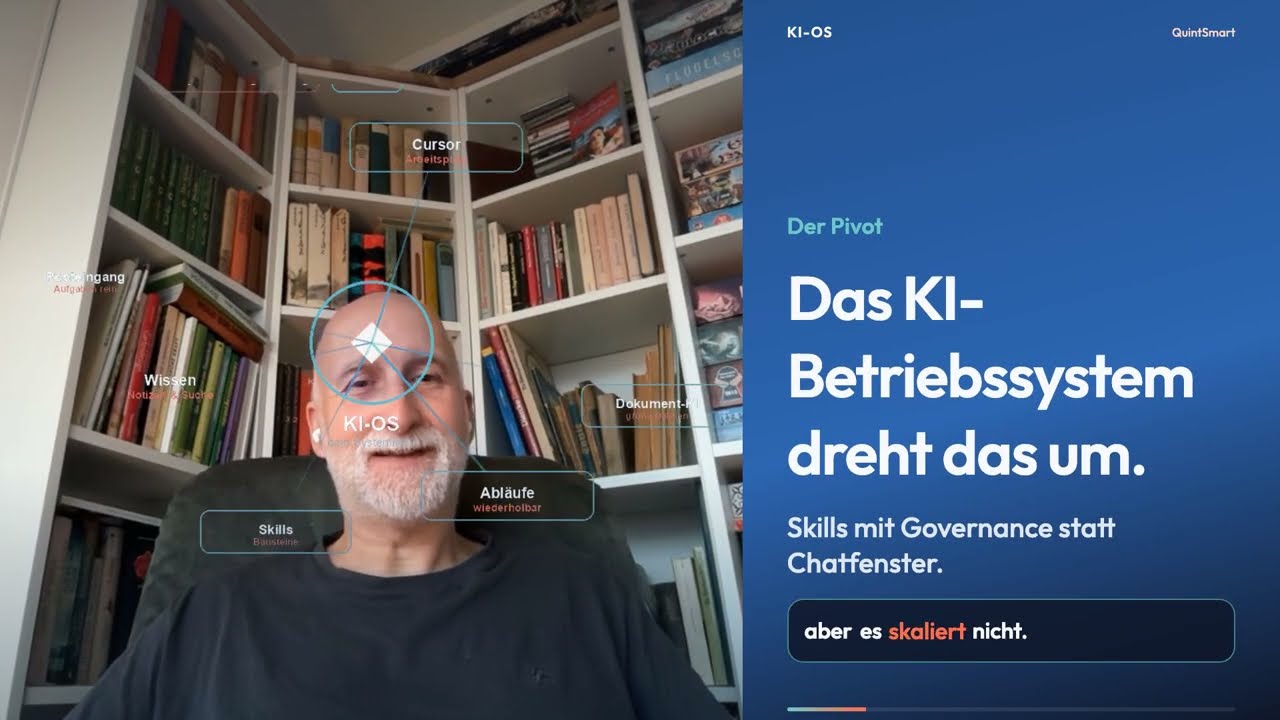
Die KI hilft. Dein Wissen noch nicht. Und die echte Arbeit bleibt liegen. Dein Wissen arbeitet endlich mit. QUINTSMART · NEWSLETTER Die KI hilft. Dein Wissen noch nicht. Und die echte Arbeit bleibt liegen. Vier Stunden, um ein Video fertigzustellen. Acht offene Tabs, weil du nicht mehr weißt, wo das Wissen von letztem Jahr abgelegt ist. Und ein Chat-Fenster, das bei jedem Gespräch neu anfängt, als gäbe es kein Gestern. Das ist kein KI-Problem. Das ist das Ergebnis, wenn KI als...
Welches Modell wofür? Was ich lange übersehen habe – und was wirklich zählt bei der Modellwahl. QUINTSMART · NEWSLETTER 48 Welches Modell wofür? Hey , ich habe lange die falsche Frage gestellt. Wenn ich neue KI-Modelle ausprobiert habe, dachte ich immer: Welches ist das beste? Welches nehme ich? Ich habe einfach ausprobiert, verglichen, gewechselt. Hauptsache ein gutes Modell gefunden. Was ich dabei nicht gesehen habe: Ich war die ganze Zeit auf der Oberfläche unterwegs. Ich habe nie gefragt,...